Pastéis de nata are Portuguese custard tarts with crisp, flaky pastry and a creamy, cinnamon-kissed center. This home-friendly version uses store-bought puff pastry, so you can make a batch of warm, golden tarts without spending the day stretching dough. They are lovely with coffee, for brunch, or as a small dessert after dinner.
The secret is a very hot oven, chilled pastry, and custard that is thick enough to stay in the shells. If you enjoy baked custards, try our classic crème brûlée; for a chilled coffee dessert, our easy tiramisu is another make-ahead favorite.
What makes a great pastel de nata?
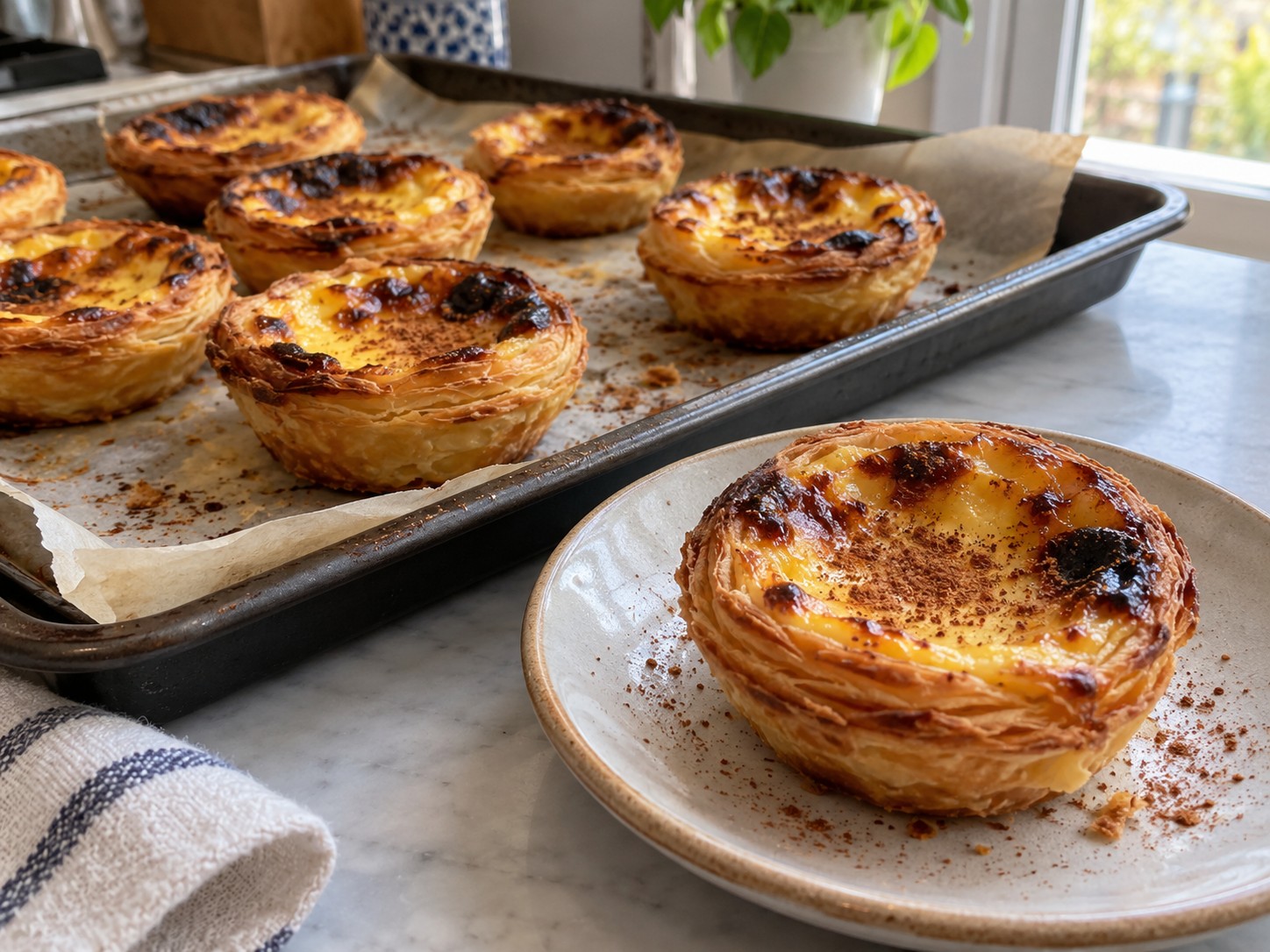
A good pastel de nata has thin pastry layers that shatter at the bite, a custard that tastes of egg yolk and vanilla, and a surface with dark caramelized spots. Traditional bakeries often make their own laminated dough. Puff pastry gives home cooks a practical shortcut while keeping those buttery layers. The custard gets its gentle citrus note from lemon zest and its familiar warmth from cinnamon.
Ingredients and helpful notes
Use a quality all-butter puff pastry if available and thaw it in the refrigerator so it stays cold and easy to handle. Whole milk and cream make the filling tender; egg yolks and cornstarch help it set. A cinnamon stick and a strip of lemon peel infuse the dairy without leaving bits in the custard. Keep the zest broad and avoid the bitter white pith. A 12-cup muffin tin works well for this home version.
How to make Portuguese custard tarts
Start by heating the oven to 500°F (260°C), or as high as your pastry package recommends. Roll the pastry into a tight log, cut it into 12 rounds, and press each round into a muffin cup. Keep the base thin and push the dough slightly higher than the rim, since it will shrink as it bakes. Chill the lined tin while you prepare the filling.
Warm the milk and cream with cinnamon and lemon peel until steaming, then let them steep briefly. Whisk sugar, yolks, cornstarch, vanilla, and salt until smooth. Slowly whisk in the warm dairy, return the mixture to the saucepan, and stir over medium-low heat until it thickens lightly. Strain the custard and let it cool for about 10 minutes; very hot filling can soften the pastry before baking.
Fill each shell about three-quarters full and bake until the pastry is deeply golden and the custard has dark brown blisters, about 10 to 13 minutes. Ovens vary at this temperature, so watch closely near the end. Let the tarts cool in the tin for 5 minutes before loosening them carefully. The centers settle as they cool. Serve warm or at room temperature with a dusting of cinnamon.
Tips for crisp pastry and creamy filling
- Keep the pastry cold while shaping; warm dough can slump before the layers puff.
- Do not overfill the shells. Custard expands in the oven and may spill over.
- Whisk continuously as the custard thickens to prevent lumps or scorching.
- Let the tarts cool before removing them; the pastry is fragile while hot.
- For the signature dark top, use a hot oven and bake on a lower-middle rack, checking often.
Storage and serving
Pastéis de nata are best the day they are baked, while the pastry is crisp. Because the custard contains milk and egg, refrigerate leftovers within 2 hours (within 1 hour if the room is above 90°F/32°C), in a covered container, and use within 3 days. Reheat in a 350°F oven until hot. Follow the USDA’s leftover food-safety guidance; avoid leaving custard tarts at room temperature for extended storage.
Frequently asked questions
Can I make the custard ahead?
Yes. Make it a day ahead, cover it, and refrigerate. Whisk briefly before filling the pastry shells. The pastry should still be shaped and baked shortly before serving for the best crunch.
Why did my pastry turn soggy?
The pastry may have warmed before baking, the custard may have been too hot, or the oven may not have been hot enough. Chill the lined tin, cool the custard briefly, and fully preheat the oven.
Estimated nutrition
Approximate values per tart (1 of 12); nutrition varies with the puff pastry brand and exact portion size.
| Nutrient | Amount |
|---|---|
| Calories | 220 kcal |
| Carbohydrates | 22 g |
| Protein | 4 g |
| Total fat | 13 g |
| Saturated fat | 7 g |
| Fiber | 1 g |
| Total sugars | 10 g |
| Sodium | 140 mg |
These values are estimates for general information. See the recipe card for the ingredient list, timing, and full method.
Pastéis de Nata (Portuguese Custard Tarts)
Ingredients
Method
- Heat the oven to 500°F (260°C). Lightly grease a 12-cup muffin tin.
- Roll the thawed pastry into a tight log, cut into 12 equal rounds, and press each round into a muffin cup, spiraling the layers upward to form thin shells. Chill the tin while making the custard.
- Warm the milk, cream, cinnamon stick, and lemon zest in a saucepan until steaming. Remove from the heat and steep for 5 minutes; discard the cinnamon and zest.
- Whisk the sugar, egg yolks, cornstarch, vanilla, and salt until smooth. Slowly whisk in the warm milk mixture, then return it to the pan. Cook over medium-low heat, whisking constantly, until lightly thickened; do not boil. Strain and cool for 10 minutes.
- Fill each pastry shell about three-quarters full. Bake 10 to 13 minutes, until the pastry is deeply golden and the custard has dark brown spots. Watch closely near the end.
- Cool in the pan for 5 minutes, loosen carefully, and transfer to a rack. Serve warm or at room temperature with a little cinnamon.